
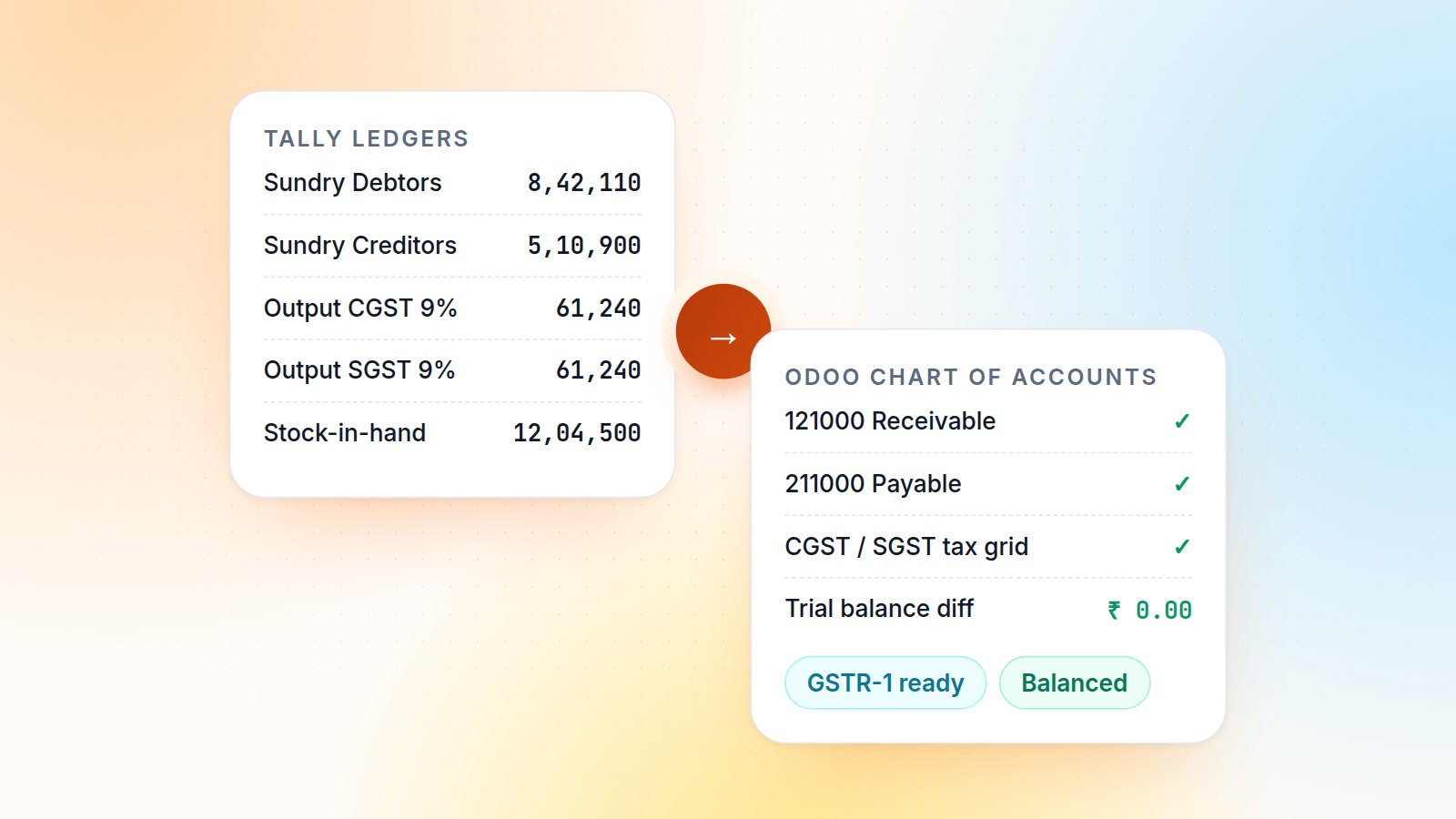
Most Indian SMEs I work with run their books in Tally before moving to Odoo. The motivation is almost always the same: accounting is in Tally, but sales, purchase and stock live in spreadsheets, so nothing ties together. Moving to Odoo fixes that, but only if the accounting data comes across cleanly. Here is the plan I follow.
Pick the cut-off date first
Choose a clean boundary, ideally the start of a financial year (1 April) or at least the start of a GST return period. Everything before it stays in Tally for reference. Odoo starts with opening balances on the cut-off date. Migrating years of historical vouchers rarely pays off and doubles the reconciliation work.
Map ledger groups to Odoo accounts
Tally organises ledgers in groups. Odoo uses account types. A mapping sheet agreed with the client's accountant is the backbone of the project:
| Tally group | Odoo |
|---|---|
| Sundry Debtors | Customers (contacts) + Receivable account |
| Sundry Creditors | Vendors (contacts) + Payable account |
| Bank Accounts / Cash-in-Hand | Bank and cash journals |
| Duties & Taxes | GST tax accounts (CGST, SGST, IGST, TDS) |
| Stock-in-Hand | Stock valuation account, fed by inventory |
| Sales / Purchase Accounts | Income and expense accounts |
Customers and vendors become contacts with their GSTIN, state and PAN, not accounts. This is the single biggest conceptual change for Tally users.
Bring open items, not just balances
Importing a single opening balance per customer is quick, but it breaks ageing reports, follow-ups and payment matching. Import each unpaid invoice and bill as an open item on the cut-off date, with its original number, date and due date. Then customer payments received after go-live reconcile against the right invoice from day one.
Stock and valuation
Stock items become products with their HSN code, unit of measure and taxes. Godowns become warehouses or locations. Load opening stock with an inventory adjustment at the agreed cost, choose the costing method (AVCO or FIFO) up front, and check that Odoo's valuation equals Tally's stock-in-hand on the cut-off date.
GST in Odoo
Install the Indian localisation. It provides the chart of accounts, CGST/SGST/IGST taxes, fiscal positions for inter-state supplies and GST-ready invoice layouts. Depending on your edition and needs, the GST return reports, e-invoicing and e-way bill modules sit on top. Test intra-state and inter-state invoices, reverse charge and credit notes before go-live.
Reconcile to the last rupee
- Compare the trial balance of Tally and Odoo on the cut-off date, group by group.
- Compare party balances: every customer and vendor, not only totals.
- Compare stock valuation per warehouse.
- Get the accountant's sign-off before the first live transaction.
When Tally has to stay: integrating instead
Some groups keep Tally for statutory accounting while operations move to Odoo. Tally exposes an XML interface over HTTP (port 9000 by default), so Odoo can push sales and purchase vouchers and read masters automatically:
import requests

payload = """<ENVELOPE>
  <HEADER><TALLYREQUEST>Export Data</TALLYREQUEST></HEADER>
  <BODY><EXPORTDATA><REQUESTDESC>
    <REPORTNAME>List of Accounts</REPORTNAME>
    <STATICVARIABLES><SVEXPORTFORMAT>$$SysName:XML</SVEXPORTFORMAT></STATICVARIABLES>
  </REQUESTDESC></EXPORTDATA></BODY>
</ENVELOPE>"""
response = requests.post('http://tally-server:9000', data=payload.encode(), timeout=60)
The same rules apply as for any integration: a mapping table, idempotent pushes (store the Tally voucher number), and a log of what failed and why.
Summary
A Tally to Odoo move succeeds on preparation: a clean cut-off, an agreed ledger mapping, open items instead of balances, and a reconciliation signed off by the accountant. Planning the switch? Let's plan your cut-over, or read the data migration playbook in my implementation guide.

Gautam Kundaria
Odoo Techno-Functional Consultant with 5+ years of implementing, migrating and customising Odoo for businesses worldwide.
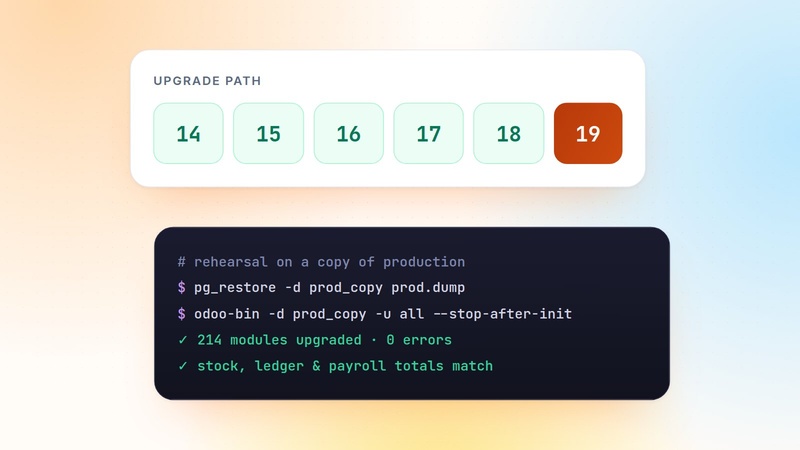
The Odoo Migration Playbook: From v14 to v19 Without Losing Data
Migrations fail on surprises, not on code. This is the step-by-step playbook I follow to move Odoo databases from v14 to v19: inventory, porting, rehearsals, validation and go-live.
 Gautam Kundaria
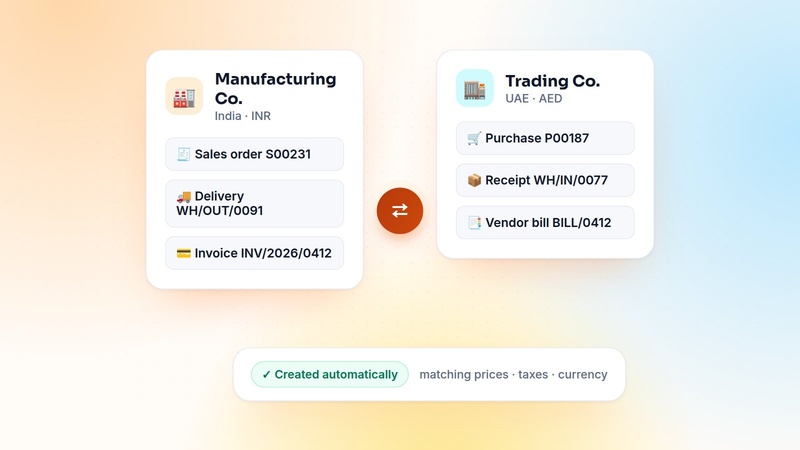
Inter-Company Transactions in Odoo Multi-Company: Sales, Purchases and Stock on Autopilot
Groups that trade between their own companies waste hours re-typing documents. How to automate inter-company sales, purchases, stock transfers and invoices in Odoo, with or without Enterprise.
 Gautam Kundaria
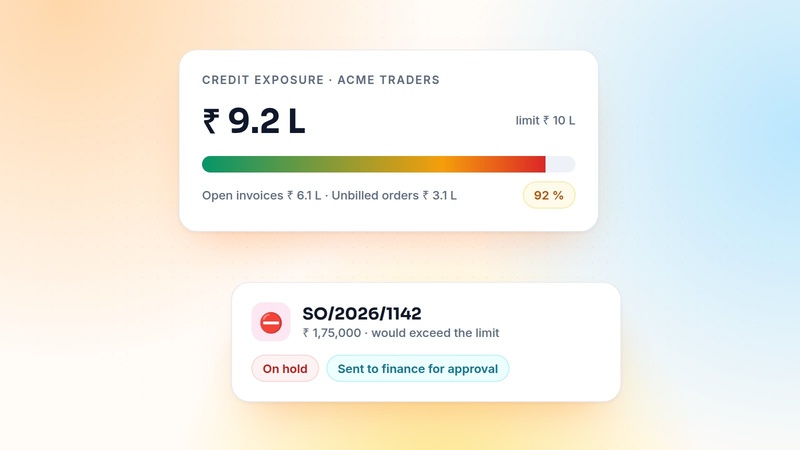
Customer Credit Limits in Odoo: Warn, Hold or Block Risky Orders
Odoo can warn salespeople when a customer goes over their credit limit, but it won't stop the order. Here is how to count the real exposure and put risky orders on hold for finance.
 Gautam Kundaria